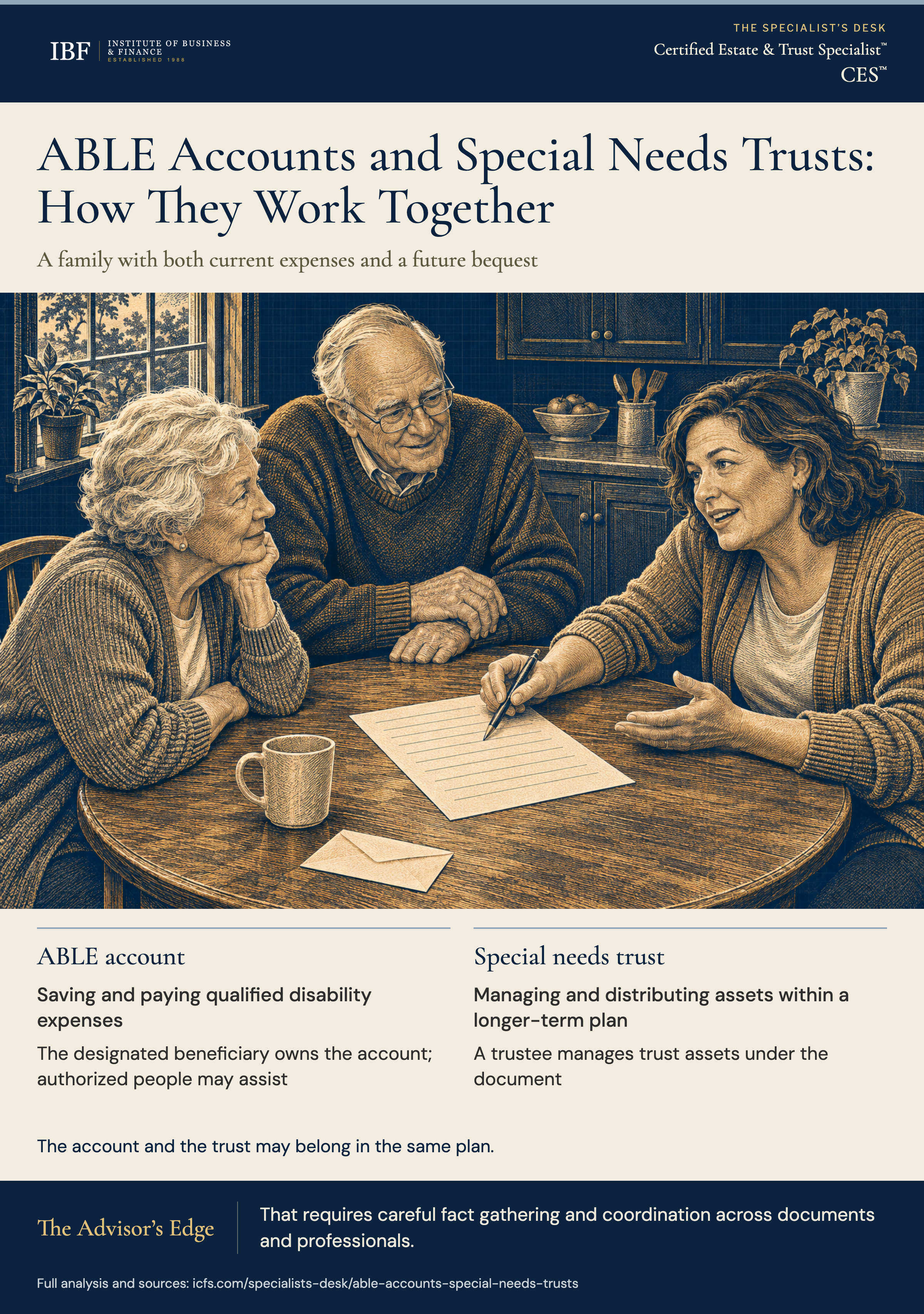
An ABLE account can give an eligible person a practical way to pay disability-related expenses while protecting benefits. A special needs trust can hold an inheritance and support a longer-term plan. Start with when the disability began, whose money is involved, and what the person needs to pay for. The account and the trust may belong in the same plan.
A client who was ineligible for an ABLE account a few years ago may qualify now. Beginning January 1, 2026, the disability-onset test expanded from before age 26 to before age 46. That changes which families an advisor should revisit. It does not mean an account must be opened before the beneficiary turns 46. SSA's ABLE guidance distinguishes the onset date from the person's current age.
The next question is how an account would fit the family's existing arrangements. An ABLE account pays qualified disability expenses. A trust has its own terms, trustee, and distribution rules. Choosing between their labels skips the work that determines whether either arrangement helps.
Start with eligibility and the money's owner
Ask when the qualifying blindness or disability began. Then establish how eligibility will be documented. Receiving a disability benefit can be one route, but it is not the only one. A qualifying disability certification is another. Do not assume every health condition qualifies or that a current diagnosis proves the required onset date. SSA's ABLE guidance explains the benefit and certification routes. Check the required physician documentation and the plan's eligibility process before funding.
Next, identify the owner of the money. Parents planning a future bequest are making a different decision from an adult who has already received a settlement. A third-party special needs trust holds assets supplied by someone other than the beneficiary. A first-party arrangement involves the beneficiary's own assets and different statutory requirements. An individual first-party special needs trust generally must be established for a disabled beneficiary under age 65 to meet that statutory exception; later additions generally do not qualify. Pooled trusts have separate rules. An ABLE account belongs to its designated beneficiary.
That distinction matters before a transfer occurs. Do not move a beneficiary's money into a parent's trust merely because the document has “special needs” in its title. Ask the attorney to confirm the trust's funding rules and benefits treatment first.
Give each arrangement a job
An ABLE account offers a way to save and spend for qualified disability expenses. These can include education, housing, transportation, employment support, and other expenses related to the person's disability. Tax-free treatment depends on how distributions are used. Federal tax treatment and any state contribution incentives also need to be considered separately. Use current-year guidance for contribution limits; do not assume the ABLE ceiling and annual gift-tax exclusion are identical. The current figures and their IRS source appear below.
A trust can provide a structure for managing family wealth over a beneficiary's lifetime. Its trustee controls distributions under the document and applicable law. It can also set out what happens to remaining family assets after the beneficiary's death. Trust drafting and benefits consequences require specialist review.
Here is a useful division of responsibilities:
| Planning question | ABLE account | Special needs trust |
|---|---|---|
| Who owns or controls the assets? | The designated beneficiary owns the account; authorized people may assist | A trustee manages trust assets under the document |
| What is the immediate task? | Saving and paying qualified disability expenses | Managing and distributing assets within a longer-term plan |
| Can a large inheritance go straight in? | Annual contribution limits restrict funding | Funding depends on trust type, ownership, and drafting |
| What must be reviewed? | Eligibility, contribution room, spending records, benefits rules, and state plan terms | Funding source, trustee powers, distribution treatment, and remainder provisions |
For 2026, the ordinary aggregate ABLE contribution limit is $20,000; the annual gift-tax exclusion is generally $19,000 per donor, per recipient. Other gifts from that donor to the same person use the same exclusion. An amount that fits within the account limit can still require a gift-tax reporting review. These are different tests, as shown in IRS Revenue Procedure 2025-32, sections 4.34 and 4.42. An ABLE account's annual limit applies across contributors. A gift from a grandparent uses some of the same contribution room as a parent's contribution. Additional contributions may be available for an eligible working beneficiary, subject to separate conditions. Confirm the current limit and all contributions before recommending another deposit.
Benefits depend on the transaction
The first $100,000 in an ABLE account is excluded from the individual's SSI resource calculation. That is an SSI rule, not a universal maximum account balance. State program limits are a separate issue. If the excess ABLE balance causes countable resources to exceed the SSI limit, cash benefits can be suspended; SSA's representative-payee guidance explains that Medicaid may continue under the applicable conditions.
Money withdrawn from the account needs its own review. A housing distribution retained into the following month can become a countable resource for SSI. “It came from ABLE” does not settle every question about money sitting in a checking account. Plan the withdrawal, payment, and documentation together.
Trust distributions also require transaction-level analysis. A trust qualifying for an exception is not enough to establish that every distribution preserves every benefit. SSA's special needs trust instructions expressly require further resource evaluation. Have the trustee and benefits specialist confirm the proposed payment before relying on a general description of the trust.
A family with both current expenses and a future bequest
Suppose a client's daughter is 52 and her qualifying disability began at 38. Those ages illustrate why the expanded onset test matters: her present age does not itself rule out ABLE eligibility. Documentation and the other requirements still have to be satisfied.
Her parents want to help with transportation now and leave assets for her later. Treat those as separate funding decisions. They could investigate an ABLE account for current qualified expenses while asking an attorney to review a third-party special needs trust for the future inheritance.
Where the trust terms and applicable rules permit, the trustee may also contribute directly to the beneficiary's ABLE account. SSA distinguishes a trust-to-ABLE transfer from cash paid directly to the beneficiary: the former is excluded from SSI income, while the latter is generally unearned income. Confirm the trustee's authority and unused ABLE contribution room before using this route. This comparison assumes the trust principal is not already a countable resource. Payments already belonging or due to the beneficiary, such as wages, keep their usual income treatment even if deposited directly into ABLE. Moving money through the beneficiary's checking account first can also change the analysis.
Before funding the account, check contributions already made by relatives. Before changing the estate plan, review the will and beneficiary forms. A trust document sitting in the attorney's file does not redirect an account that still names the daughter outright.
This is a planning example, not a conclusion that both arrangements are necessary for every family. The daughter's benefits, spending needs, existing documents, and state rules determine the answer.
Where the comparison stops
Neither arrangement makes benefits administration automatic. Fees, investment options, authorized-person procedures, state rules, and the beneficiary's ability to manage spending can change the practical choice. An account invested for long-term growth may be a poor place for next month's housing payment.
Death-benefit treatment also deserves a separate conversation. An ABLE reimbursement claim generally concerns Medicaid assistance paid after the account was established, with adjustments for applicable Medicaid Buy-In premiums and outstanding qualified disability expenses. State policies, prior account rollovers, and separate Medicaid estate-recovery rules also need to be checked. This is a comparison of the direct account and trust claims, not every possible estate-recovery route. The individual first-party trust exception generally requires payback for Medicaid assistance paid on the beneficiary's behalf, rather than only assistance after the trust began. A properly structured third-party trust funded solely with other people's assets generally does not carry that first-party payback requirement. Do not promise identical remainder treatment across all three.
The advisor's role is to identify the issue, gather the financial information, and coordinate with the attorney and benefits specialist. Legal drafting and a benefits determination cannot be replaced by an account comparison chart.
The client conversation
“The rule changed who we should consider for an ABLE account. Let's confirm when your daughter's disability began and which benefits she receives. Then we'll separate what you want to help her pay for now from what you want to leave her later. We can take that information to the attorney and decide how the account and trust should work together.”
Follow that conversation with a short written record: eligibility evidence to obtain, current contributions to confirm, payments to coordinate, documents to review, and who owns each next action. Avoid opening an account first and asking the benefits questions afterward.
Key Takeaways
- Check disability onset before screening someone out because of their current age.
- Identify whose assets will fund the arrangement before discussing trust type.
- Coordinate contributions across family members and check current-year limits.
- Review the timing and benefits treatment of withdrawals and payments.
- Match the estate documents and beneficiary forms to the intended funding plan.
The Advisor's Edge
The eligibility rules and plan disclosures are public. A family can read them without an advisor.
The harder work is connecting those rules to an inheritance, a housing payment, a trustee's instructions, and the benefits the person actually receives. That requires careful fact gathering and coordination across documents and professionals.
The Certified Estate & Trust Specialist™ program develops the trust-analysis and estate-planning coordination skills behind those conversations.
For the broader trust framework, read Types of Trusts Every Financial Advisor Should Know.
Sources and Notes: Federal eligibility, tax, and benefits guidance checked November 4, 2026. Use the current ABLE-specific SSA guidance for eligibility; an older trust-guidance page linked for its distribution rule still shows the former onset age. The family example is hypothetical. Contribution figures shown are for tax year 2026. Confirm the applicable tax-year limits, working-beneficiary conditions, and state plan terms before funding.